My grandmother, my mother, my sisters, and my one day daughter live in a country where their being raped is not just possible, but likely.
Sunday, February 10, 2013
I promote the rape of my grandmother, my mother, my sisters, and my one-day daughter
My grandmother, my mother, my sisters, and my one day daughter live in a country where their being raped is not just possible, but likely.
Wednesday, November 23, 2011
Nando's pisses me off
![]() |
| Zackie Achmat lowering the flags outside Parliament |
I may be a lefty-liberal with a deep and enduring love of socialism, but my strong pragmatic streak leaves me actually being a supporter of capitalism. So that, in and of itself, would not bother me.
Sitting at my (current) day-job, Memeburn, I saw the outcome of that meeting of brand execs, Nandos' latest viral ad campaign. As we do, at Memeburn, I started writing a news article about it's release, generally about 300 words top. When I saw I'd reached 500 words and the terms "cheaps, crass and opportunistic" had been used to describe it, I realised there may be a slight issue.
Here's the article, me "flaming" Nando's, as a Twitter friend put it.
"Nando's unleashes anti-secrecy bill #BlackTuesday campaign"
Image taken by yours truly at the Right2Know protest outside parliament, the day the bill took its first step to becoming law after being approved by parliament.
Thursday, September 1, 2011
I wrote a post for the Mail & Guardian's ThoughtLeader blog.
-------
When Canadian police officer Michael Sanguinetti said “don’t dress like a slut”, he’d made a huge mistake. In fact he’d touched that rock the women who’d made their way up to the Union Buildings in 1956 had warned against.
Sanguinetti’s words, uttered a few months ago when giving university students safety tips, found me waking up this past Saturday morning to take part in the Cape Town leg of a global movement known as “Slutwalk”, a hot potato of a name I’ll soon get to.
The aims of Slutwalk are … this is where the issues arise.
Click here to read the rest.
Thursday, March 31, 2011
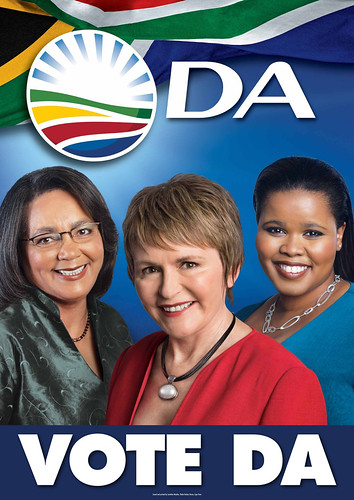
DA2.0: The DA I Wished For
25 June 1955, the Kliptown Conference was convened, from which the cornerstone of our constitution, The Freedom Charter, was debated and promulgated. Fast-forward some 56yrs, and it looks like yet again Kliptown will take another page in South Africa’s history books as the DA ostensibly launched their election manifesto for this year’s municipal elections. However, what happened there was far more than that.
Last Saturday, the DA unveiled itself as an entirely new party.
It was most certainly no longer the party of the much maligned 1999 “Fight Back,” campaign or the 2009 “Stop Zuma” drive; a party which had to rebut robust attacks from the ANC and press of being a “white,” and “negative,” party; essentially, a purely opposition party.
In it’s place what took the stage was a party clearly seeking to not be merely relegated to the seats of the opposition, a party hungry to win, and win as much as they can. To quote their slogan a party which “delivers for all.”
As impressed as I was, since Saturday I’ve been trying to understand the DA’s electoral strategy of focusing on service delivery with regards to capturing that undeniably integral black vote. For the black middle class, so-called Black Diamonds, it was obvious. The DA fairly believes that by highlighting what they have done in Cape Town – brought some sense and order to the city – they will capture that vote. However, I didn’t understand how they thought that would lead them to electoral success as the black middle class is not the majority of black South Africans, it is the black working class, and they, more than black South Africans as a whole, are the key to any meaningful electoral gain.
After countless hours listening to their speeches and analysis of the speeches; reading their documents, and analysis of those documents, following the DA twitterati on Twitter, it’s ironic then that all it took was for their 30sec ad spot, with a sweet Gogo telling how the DA has delivered for her, to make sense to me.
With that ad, what I saw was that the DA, could also gain success using this service delivery angle. The open toilet saga of course did nothing to dispel the prevailing image of the DA as a party concerned with dealing primarily with the concerns of their electorate, the suburbs. The truth is the DA has, and does also focus on delivering service and bettering the life of South Africa’s poor.
Everyone knows the phrase, “all politics is local,” and taken to it’s most extreme this can mean “am I fed? am I clothed? Do I have a roof over my head?” If the DA can prove that they can and deliver all these things, it wouldn’t be insane to believe the angry, dissatisfied at service delivery failure voter would turn to the DA.
Many times I’ve written it and said it; service delivery protests are a sign that our democracy is failing and not because of the ANC’s failure to deliver, but because the opposition – and by opposition I mean DA – does not speak to the needs of the average voter – and by average voter I mean black working class voter. Clearly though, with this campaign, they’re clearly trying to do that, and for that I applaud them.
But of course, there’s a ‘but.’
I’ve voted twice, ID in 2006 & COPE in 2009. Though at the time when asked, I would sidestep the question, I’ve never for a moment even considered voting for the DA. To put it bluntly, I believed that the DA was a party that sought to cater to the minority and had no interest in my interests, and with their actions to me reaffirming that, nothing they said would dissuade me of that.
It was only last month I wrote to a friend on Twitter, Zama, as we discussed the DA saying, “that the DA has failed to speak to my aspirations is a failure on their part, not mine.” As we lamented how “disappointed” we were in the ANC, Zama summed up how I felt when she said she’d rather not vote, than vote for the DA. She again perfectly captured how I felt when she said, “Ultimately a voter is a customer paying through their taxes…We choose a product that speaks to our needs.” I can’t speak for Zama, but personally looking over those tweets after Saturday, I didn’t feel that they applied to this new DA.
It then of course stands to reason to wonder; if as a “disappointed” supporter of the ANC’s agenda, faced with a DA that is no longer “a party purely for the minority” could I, or would I vote for them?
No.
It’s not because I believe the DA is a “white party,” which since Saturday more than ever it clearly is not. However, the reason I still wouldn’t vote for the DA is because when everything is boiled down I fundamentally disagree with their core policies.
Yes, I want good governance, and am as angry as any other South African when every two seconds I hear of yet another example of ANC wastefulness, corruption & cronyism. However, I also don’t feel that the DA, with it’s emphasis on potholes, rubbish collection and the like speaks to my aspirations. To be fair, these being local elections, potholes, rubbish collection and the sorts are the issues that are being dealt with.
However, the DA has given us “The Cape Town Story.”
In the grandiose manner of all political manifestos, it states, (the story) began on the 1st of March 2006, a day “future generations will recognise” as being a “watershed” for South Africa, as it was “the first time since 1994, citizens removed an incumbent political party through the ballot box.” Moreover, in this document is found the essence of the DA: “The Open Opportunity Society for All.”
This vision, or philosophical orientation as the DA refers to is based on the idea that South Africans are “free and equal in rights,” that “each has the opportunity to go as far as their talents will take them,” a ours is a society “in which every South African has the space to be whatever they wish to be.”
That, I disagree with fundamentally.
It’d be easy to say that this philosophical orientation directly opposes what Lindiwe Mazibuko who said, “we live in a decidedly unequal society,” but giving the DA allowance for electioneering grandstanding it is clear Mazibuko was espousing the DA’s view.
Even though the “philosophical orientation” of the DA does have the bluster of electioneering I’d argue that it speaks directly to their average existing voters whom I find do believe that to be the South African reality, however that is another matter for another day.
In essence, I believe the DA does recognise that South Africa is not an equal society but as Mazibuko said “we differ from the ANC on the method of addressing these imbalances.” Gareth Van Onselen, national head of the DA’s 2011 election communication, said as much to me in a discussion I had with him on Twitter.
However, as Van Onselen put it – to use a term The Cape Town Story, prefers when referring to ANC government but one Van Onselen didn’t – the current “regime’s” policy of democratic representivity is racist, not because it’s bigoted, but because it is “legislated discrimination.”
Van Onselen was also kind enough to provide me with a document on the DA’s policy on transformation and it reinforced what I believed. Though there may be questions and doubts I have about the policy itself, they do have one, and do recognise inequality is a problem in South Africa.
In my, and the opinion of others far smarter and more well read than I am, the structural inequalities in South Africa as a result of Apartheid are South Africa’s most pressing concern. As Prof. Sampie Terreblanche in his seminal, “A History of Inequality In South Africa,” concluded; real redress in South Africa has not occurred in South Africa nor will it with our current economic system; a system that came about from our negotiated settlement, the elite compromise, Professor Terreblanche terms it, a compromise that ceded political power to the black majority but left real economic power in the hands of white South Africa.
I agree with Prof. Terreblanche and believe our post-1994 economic system makes real redress impossible, both the DA and ANC recognise we need it. However, they have very different policies on how to get there.
Beyond that though, I question just how serious of an issue the DA sees it as.
If the Cape Town Story is to be seen as “a template for a truly free South Africa,” as its subtitle says, why is there no section on transformation? Why is it the only time that transformation is mentioned is in a quote from Helen Zille’s Budget Speech of 2008, where she disparaged transformation and then reframed it to mean providing, “excellent basic services to all?”
Just as I cannot like another lamb to the slaughter vote for the ANC even though I know they are in no way truly committed to dealing with cronyism, the root cause of why their policies do not work, I also cannot vote for the DA, a party which does not recognise the need for transformation to be South Africa’s primary concern.
It may feel like it, but it wasn’t too long ago when Moeletsi Mbeki said South Africa’s Tunisia Day would come in 2020. In a blog I wrote on that topic, in support of that, argued that South Africa could face a Tunisia Day if people do not feel that they have a credible opposition to vote for, a not so subtle swipe at the DA.
Electorally, as a strategy, I feel that the DA is on the right track. They are reaching out beyond the dappled sunshine leafy enclaves of South Africa’s suburbs into the townships of South Africa and that can only be good for democracy.
I wish I could say that I tweeted this, but there were two tweets, both sent as the DA2.0, the DA that I believe to be the DA I’d always been dreaming of was launched. One was from Gus Silber who wrote:

Though Sipho Hlongwane fairly questioned the DA’s use of struggle language, saying they “mixed like oil and water,” the launch as a whole recast the DA as a whole new party.
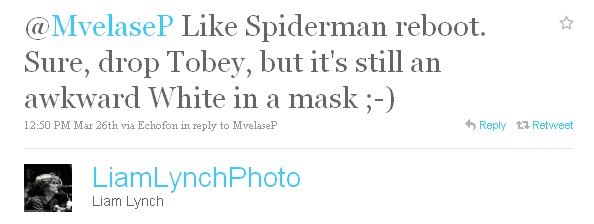
The second tweet was one at the time I felt, though funny, was somewhat cynical. In reply to my asking if it was just me who felt that the launch was the DA turning a corner, Liam Lynch said:

It’s sad to say, but that to me does sum up DA 2.0. It looks all shiny and new, but underneath that veneer, it’s the same old party that it always was.
Thursday, February 24, 2011
Tunisia: The Crystal Ball for South Africa?

An article arguing what a government is doing is wrong, and stating what it should be doing is in no way groundbreaking. However, this one, by the other Mbeki, Moeletsi, brought the wrath of the ANC down upon him. To paraphrase a favourite line, he touched the ANC on its studio when he wrote, “I can predict when SA’s "Tunisia Day" will arrive.”
However, even that idea, that South Africa will one day face a Tunisia or Egypt style uprising, is only a glib update of that classic rejoinder: "South Africa will be Zimbabwe." To quote the ANCYL on Mbeki & his article in their reaction, I’d merely dismissed such comparisons as a “prophecy of doom,” “very pessimistic,” & “consistently negative.” Whilst those descriptions I used to ascribe to those who made these arguments, with Moeletsi I can’t.
Be it, the state largely being able to foster a fair level of economic growth but unemployment remaining an endemic problem, or there being ‘youth bulges’ in all three cases, there are far too many parallels between the situations in Tunisia, Egypt & South Africa to dismiss the comparisons. However, the one similarity South Africans would most probably recognise more than any of the others, is how both in Tunisia & Egypt you had a symbiotic and at times corrupt relationship between business and government which also excluded the population at large.
It goes without saying that the ANC was not happy with Mbeki’s article, and the Youth League even less so.
Whilst Sipho Hlongwane , in his column on this topic, found the ANCYL’s reply to be besides the point, I can’t agree, if anything I found it to be an amplification of the ANC’s statement. Amazingly (after the usual bluster and ad hominem attacks) the ANCYL was able to create fair defence to Mbeki’s argument which was:
The Tunisia-like protests will not happen in South Africa, because the ANC government has made profound progress in placing institutions, structures and virtues of democracy, which allow the people of South Africa to freely and fairly choose public representatives after every five years. Besides entrenched democracy in South Africa, the ANC government is at the forefront of the attack in the battle against poverty, unemployment and starvation.
One cannot deny “the ANC government has made profound progress in placing institutions, structures and virtues of democracy,” & that it, “is at the forefront of the attack in the battle against poverty, unemployment and starvation.”
However, there is one point, which I’d say, were it true, would be the most important fact against any argument that there’re correlations between South Africa, Tunisia: “entrenched democracy in South Africa”.
Though the ANCYL's argument in reply to Mbeki was fair, it wasn’t correct, as that point, "entrenched democracy in South Africa" was incorrect.
If one takes that when the ANCYL say “entrenched democracy,” they mean democracy is accepted within our nation, you’re looking at the concept of a “consolidated democracy;” a concept used essentially to gauge the quality of a democracy.
I used to believe that South Africa was well on the road to being a consolidated democracy. Amongst fulfilling the other factors, I thought for SA, democracy was “the only game in town,” a necessary factor of a consolidated democracy. I believed we were only missing the final factor, "a peaceful transfer of power from one party to
another after electoral defeat," however I don’t think that any longer.In South Africa, a basic tenet of a consolidated democracy, that democracy be the "only game in town," is not satisfied.
When looking at the violent nature of the ongoing service delivery protests or strikes public sector or otherwise, how can we believe that people feel and accept that their grievances are best articulated through democratic channels.
As such, if the ANC and the ANCYL, or Hlongwane for that matter, feel that our being a democracy inoculates us from Tunisa-style revolts then there is a problem. Being a democracy – which we are – is not enough to spare us a Tunisia situation at some point in South Africa’s future.
When looking for a point when South Africans would – and it will happen – decide they’re no longer happy with the ANC, I’d always thought of a date far off into the future. Mbeki makes a case for 2020, but the question of when it happens is irrelevant; what we have to ask is "when it happens will it be through the ballot or violently?".
Nevertheless, to use Moeletsi Mbeki’s 2020 argument, should the day come “that the ANC government will have to cut back on social grants, which it uses to placate the black poor,”; I can’t agree with Sipho’s reply that “our burning man revolution will be at the ballot box,” for Sipho is incorrect in finding proof from the peaceful transition from ANC to DA government in the Western Cape that South Africa has proven itself to be able to handle transfers of power.
In the 2020 scenario, it’d be the nation as a whole where a transfer of power would have to occur & what we have seen in places like Khutsong or Thembisa, is that South Africans cannot be depended upon to express their dissatisfaction on the ballot.
More so, as history has shown, movements are catching. If the self-immolation of one man, Mohamed Bouazizi, can spark the fire that topples a regime, how can we then deny that an instance of violent protest, in the simmering anger of the 2020 scenario, it wouldn’t spread across the country, as happened in 2009?
If America, 235 years old, to this day still strives for a “More Perfect Union,” how can we, only 16yrs old or 26 years old in 2020, feel that we are safe?
The quest of entrenching democracy & democratic ideals within us as a nation is clearly not done. We all – government, opposition parties, civil society, the population as a whole – still have a lot to do in this regard or one day we won’t be watching a popular uprising in some distant land on Al-Jazeera, we’ll be witnessing it in the streets & public squares of our own country.
Tuesday, February 1, 2011
The ‘Bling’ Of South Africa

This was a blog I wrote at the time of Khanyi Mbau’s interview with Debora Patta, but never posted. With this debate, again, coming to the fore after the publication of this picture on the front page of The Times yesterday, I figured now is as good a time as ever to post it.
__________________________________________________
I can’t think of a single interview of Khanyi Mbau’s that doesn’t immediately spark off a slew of controversy and her recent turn with Debora Patta on 3rd Degree was no different. There more quotes there to achieve exactly what it was the indefatigable Ms Mbau wanted; to get her those headlines - for those who missed it, “blue cheese on a croissant,” is the 21st South African answer to Marie Antoinette’s cake.
Whilst of course, the interview was interesting in and of itself just because Khanyi Mbau, as much as it pains me to admit it, is fascinating as a character, if not so much as a person, there was a far deeper undertone to the interview. As 3rd Degree framed it, the programme was a look at the ‘bling lifestyle,’ of some of the South African elite. Though this is nothing new to the gossip pages, it burst into the wider public psyche after the Kenny Kunene’s equally famous and infamous 40th birthday party, particularly after Zwelinzima Vavi’s scathing attack on it and Kenny’s just as scathing open letter to Vavi.
From this a vociferous, yet important debate on where we, as a culture are going, and who we are erupted. To many, as shown by Vavi and his many supporters, Kenny, Khanyi and their ilk are a living, breathing, blinging representations of the pervesion of the South African democracy. Even I’m so tempted to say, that any sensible person would agree, amongst which I would number myself. However, I can’t.
Who Are We
The government oft repeats, these are foreign and alien notions to South Africa and yes; a South Africa where a small minority live a life of wealth and overt opulence, whilst the far larger majority lived a life of squalid poverty is not the status quo our constitution sought to engender.
However, the very system we chose to live by, the very system our constitution enshrines is a system in which the Khanyi’s and the Kenny’s flourish. However it may manifest, be it the football players and their WAGs of Europe or the starlets and rappers of Hollywood, where there is liberal democracy, our constitutional system, the ugliness of conspicuous consumption rears its head.
For me the irony of the whole issue was best illustrated on Twitter whilst the show was airing and the majority of South African Twitter users were watching and tweeting about the show, an American asked me what the big fuss in South Africa was about.
After I explained to him, his answer said it all, “Welcome to the United States.”
Is It Because They’re Black?
Thankfully, as the first salvo in this debate was shot off by a black man we can somewhat dodge the South African version of Alice’s rabbit hole, the race debate and though I hate to mention it, I would be remiss not to.
Why now, why when Kenny Kunene, a black man, is the one who is splurging his wealth about does the outcry arise? For years, both pre and post Apartheid, through the columns of Gwen Gill we were privy to the conspicuous consumption, often thinly veiled as charity functions, of white South Africans. One may do it ‘for charity,’ and the other may just do it, but be it Edith Venter or Khanyi Mbau, it’s all inconspicuously or not, conspicuous consumption.
Where Are The Parents?
Often these days where the Oprah’s and Dr Phil’s of this world explain our issues of why we are the way we are, we forget one simple thing, personal responsibility. Therefore, when Kenny, Khanyi and their supporters say, “Where are the parents, it’s not for us to be role models,” they are correct, but only to a degree.
The power is of the media and popular culture is pervasive, this we all know. Thus regardless how well a parent may raise their child, unless they raise their child locked in away from anyone and everything, not all aspects of who that child becomes is up to them. It takes a village to raise a child; sadly with the power the media holds in 21st century living, try as we may, we can’t choose who the villagers are.
When I was in university, I got heavily involved in a mentoring programme giving extra Maths and English classes to underprivileged kids. One day, talking to one of my kids, he pointed to my Puma backpack, my iPod and the clothes I was wearing. To me, these items didn’t mean anything, to Kenny Kunene even less, but to him, at 9yrs old, they represented an ideal of what he wanted to achieve, where to be one day in life.
In South Africa, where poverty is something that we face daily; be it saying goodbye to your maid at the end of the day knowing that she has a long trek to make back home, whilst you sip on your chilled chardonnay, or passing spare change to the beggar out in the hot sun whilst fiddling with the air-conditioning of your car, we all ‘spit in the face of the poor,’ as Vavi said of Kenny’s birthday. Granted, it’s at varying degrees, but just by living your average middle class lifestyle, it’s what we do. Perhaps the plain reason why Kenny Kunene, Khanyi Mbau and the others of the ‘bling culture,’ offend and anger us so is because what they do is a reflection of who we are, a grossly magnified reflection of course, but a reflection nonetheless.
Friday, January 14, 2011
When ‘It’s Only A Joke’ Doesn’t Cut It
Africans, what I know of advertising, is based primarily on Generations, through the goings on at New Horizons. Luckily for me though, I know a few people in advertising and know that though they have a shocking lack of scruples, what with their using their intelligence and talent to sell superfluous stuff to people, they’re not murderous & fornicating idiots in bad clothes. Well, come to think of it, the bad clothes still apply. Nevertheless, I’ve come to recognise that people in the ad game, more often than not, are incredibly funny and intelligent and that intelligence and humour comes across in razor sharp wit.
After four hard years of drinking and partying I finally got to walk across the stage of UCT’s Jameson Hall and get doffed on the head by a man in a funny dress, something I could’ve easily achieved for far cheaper on any given night in Cape Town’s Pink Strip, but either way it allows me to be vaguely intellectual about things I see, so let me have my say.
However, at the same time, being someone who at times has had to explain down somebody climbing onto their high horse of moral indignation at a perceived slight because of a joke, I find myself in a strange position. In writing this, I open myself to the very derisive glares and sneers that I myself give when I say, “it’s just a joke,” to those who just “don’t get it.”
1st For Woman’s ad campaigns have always had their tongues firmly placed in cheek, essentially you could sum them up to a slogan learnt by all girls in primary school, which is hardly ever truly disproven, ‘boys are stupid.’ However, there new ads, advertising a new service, a helpline for customers aren’t in that vein, and in and of themselves aren’t offensive. Having said that though, there was certainly still something about two of these ads that got to me. I went back and forth on how to describe how I felt; offended was far too strong a word, so I finally settled on, ‘uncomfortable,’ a description that fittingly I’m uncomfortable with, as it’s neither here nor there really.
In these ads, there are talking heads and the talking heads are black actors with a particular accent, the accent which the majority of black South Africans speak in, from maids to political leaders. I hate to delve into the world of ‘deconstructing & decoding,’ but that’s exactly where I’m headed. Failing to see any other place where the humour in the advertisements lay, it would seem that the ‘humour’ in the adverts lay in the accents.
This is nothing new really, after providing us cellphone tools that we just could never live without such as the X-Ray Kit, for a mere R50* companies like 35050 also gave us the, ‘Madaaaam! MADAAAM! Yoouur fooone is riiiinging,’ ringtone, just to name one example amongst many, for which the ‘humour’ was the accent.
In and of themselves, beyond their banal quality, there’s nothing offensive in these attempts at humour. However, the subtext, that there’s something funny about the accent of black South Africans trying their utmost to wrap their tongues around a foreign language. An accent that is in no way in indicator of how educated or intelligent (two things which are not related) someone is, is where I have to say – and here I go again – I’m uncomfortable. 
What this particular brand of humour seems to do is to carry on a rich and long tradition in Western entertainment. From the use of blackface in early 20th century entertainment, to Prissy & Mammy, in ‘Gone With The Wind,’ right through to these ads, there is a single thick vein that connects them all, though obviously as the years have passed it’s far more subtle. Today, instead of the overt caricature being in front of us to laugh at, the caricature is now hidden behind a flimsy façade, and represented through the accent.
One of course would not be incorrect to point out that it’s not just black South Africans which are pilloried in this way, Afrikaners, Cape Coloureds, Durban Indians and just about any other group also come in for their share of roasting. The very concerns and reservations that I have regarding the use black people as figures of humour could and have been expressed by any of these groups.
I deliberately opened this blog with a race-based joke, or attempted joke even. I have no issue with jokes about race, in fact having laughed at jokes about paedophilia, rape and a multitude of other ‘taboo’ topics, I’m the last person to take umbrage at a joke about race. However, if a joke is going to go down that route, it’d better be damned good, and these ads are nothing of the sort. They resort to a cheap tactic knowing that out there, the Anneline Botes’ and Steve Hofmeyrs and will be able to have a good cackle, all because “it’s just a joke.”
As I said at the outset, advertising people are not stupid, and they wouldn’t use this kind of ‘humour’ if they knew that it would turn-off the majority of their prospective customers. The ugly fact is this, it’s not only the Anneline Botes’ and Steve Hofmeyrs who laugh at these ads, it’s you’re everyday South African, be they ‘African’ or not who does and therein lies the real problem. Our laughter shows an ugly attitude within us. An attitude that feels that if your English, even if it’s not your first language, is somehow ‘less than,’ then you yourself are less than and are fair game for a cheap laugh.
Of course I may be wrong, it may ‘just be a joke,’ and I’m ‘overthinking it.’ But hey, I was doffed on the head by that dude in the funny dress, and one of the few things that did sink in during those four years is that, to put it simply, sometimes, despite whatever may be on the surface, things are not as they seem. Frankly though, you don’t need a piece of paper from a guy in a funny dress and hat to know that. I may be wrong, but I don’t think so.
*And a subscription charge of R5000 every other minute.
Monday, October 11, 2010
The Golden Age Of Mandela: Is It Over

“Madiba is like the biblical Moses, who took the children of Israel from the land of bondage, to the Promised Land, the land of milk & honey.” This quote from ANC spokesperson, Jackson Mthembu heralded the beginning Nelson Mandela’s birthday celebrations which can sometimes seem to stretch a good couple of months. It would seem there is an argument to be made that Jackson Mthembu missed his calling as that piece of prose is almost second to none. Only almost, as I would not discount the ANCYL’s Nyiko Floyd Shivambu, (he of the infamous Helen Zille’s sleeping around comments) being able to one up even those dizzying height of hyperbole.
I may joke, but as of late, I have noticed that there is a shift in South Africa to no longer look at Mandela in the golden hue in which he is presented. This is a debate and a critique that I welcome. The majority of comments I have read & heard on this debate have been fair & evenhanded; highlighting that South Africa’s freedom was not won by Mandela single-handedly. As Winnie Mandela is alleged to have said to the London Evening Standard, “There were many, others, hundreds who languished in prison and died. Many unsung and unknown heroes of the struggle, and their were others in the leadership too…” Other critiques have centred on his legacy purely as a politician, questioning his policy decisions, RDP, HIV/AIDS Macro-Economic policy etc. These discussions are both fair and necessary.
However, there is also a disquieting minority which whether intentional or not, strike as flippantly dismissive of Mandela’s legacy, merely scoffing, showing an attitude of, ‘Mandela, yeah whatever.’ With flights of fancy such as that of Jackson Mthembu it is east to be derisive. However, that does not change that it is also lazy and to be frank; stupid. The basis of these comments seems to be that there is no substance to the image of Mandela that we have. This notion leave me both angry and confused.
From the moment he was dubbed the ‘black pimpernel,’ Mandela became a figure shrouded in a sense of mystery. Upon his release, the mystery to a degree ended, another era in the image of Mandela came to be, the era of Mandela, ‘the living legend.’ One cannot deny that the image the world has of Mandela has transcended who he is, however, that does not mean there is no substance to the image we have of him. His name is now uttered with those of Ghandhi, Martin Luther King Jr. Mandela during his incarceration was used by the ANC as a call around which all South Africans and people around the world against the Apartheid regime could rally. Used is perhaps too strong of a term as Mandela himself was quite willing for this, to happen.
Mandela is quoted as saying: “That was one of the things that worried me – to be raised to the position of a semi-god – because then you are no longer a human being. I wanted to be known as Mandela, a man with weaknesses, some of which are fundamental, and a man who is committed, but, nevertheless, sometimes fails to live up to expectations.” Despite these misgivings, Mandela allowed himself to become what South Africa needed. Someone that no other politician or figure in South Africa could play. Mandela is a figure around which South Africans of all races and creeds could look up to and admire. Mandela was more than a hero for black South Africans; he was a hero for ALL South Africans. Mandela has allowed us to transcend the multitudes of ways we choose to separate ourselves from each other, has shown us a way forward to forgiving each other of our past wrongs or as one tweet put it, “Zuma may have fathered half the nation, but #NelsonMandelaRocks because he’s the one who raised us.
Wednesday, September 8, 2010
The Unity of The World Cup Is Gone & We’re The Better For It

Though I somewhat remember them, I was too young to truly appreciate how momentous our first democratic elections were in 1994, or how South Africa united behind the Springboks during the 1995 Rugby World Cup. For me, never had I seen South Africans be as one as they were during the Football World-Cup. At twelve noon on the 9th of June, South Africa ground to a halt and the world was introduced to the now ubiquitous sound of the 2010 Football World Cup, the vuvuzela. Though World Cup euphoria had been gripping the nation for a while prior to that moment, for me, it was only in that moment that I realised just how big of a deal the World Cup was going to be. The World Cup of course was all about the football, however, but for South Africans, the most memorable aspect of it was the sense of unity we felt. As Jackie Janse Van Rensburg, commented on a previous blog post, “to me, it was never about the game per se, I love the vibe, the unity, the pride, the positivity we have been experiencing.”
The evening of Bafana-Bafana’s encounter against Uruguay, a tweet disapproving of a comment made by CNN anchor, Hala Gorani, on air, made it’s way onto my timeline on Twitter, it said,
“Hala Gorani (#CNN) just reported that the sense of unity in SA ‘won’t last.’ WTH?!”Despite my initial response to the World Cup, by then, as everyone else was, I was fully ‘feeling it,’ and commented on that tweet with a single word, “disappointed.” I was more than a little surprised to get a response from Hala Gorani who elucidated on her statement saying,
“Wrong. I said the World Cup excitement that unifies a country (as it did in France) naturally dissipates after the event is over.”Basking in the glow of a World Cup successfully going off without a hitch; surrounded by the honking of vuvuzela’s; high on pre-match euphoria at that moment, forgetting all my pre-World Cup scepticism I admit, I immediately discarded the comment as nothing more than Western pessimism. Looking at what has been going on recently in South Africa, I could not have been more unfair and wrong, Hala Gorani was right, that spirit has dissipated.
When I first started writing this blog, I fully intended to lament this as a sad regression. Nevertheless, three weeks after starting it, I could not finish it. I wish I could chalk this up to ‘writers block,’ but I cannot, the reason I could not write it, was that I did not think this was a bad thing. In all the excitement over the World Cup, the enjoyment of the spirit of for the first time ever seeing what South African’s can accomplish when united as one nation, I forgot something that I’d always believed in; nationalism is anything but positive. Like many governments, the Apartheid regime used ‘nationalism,’ as a justification for many of its crimes, therefore that in democratic South Africa we have always shied away from that moniker is hardly surprising.
Patriotism, national pride, a spirit of ubuntu, call it what you will, it is nationalism. The very thing that those in power throughout history and the world over have used to corral their people from the most ridiculous of actions, to the most heinous of crimes. This is not at all an original thought on my part; wherever nationalism raised its ugly head, there have been those far more erudite than myself who have made this argument. Albert Einstein for example said, “Nationalism is an infantile disease… it is the measles of mankind,” or even more succinctly, William Blum who wrote, “If love is blind, patriotism has lost all five senses.”
Many would say that the national pride that we experienced in South Africa is different, that we spearheaded it, not following any directive. To have pride in yourself, or something that you can ascribe to being part of is natural to people, that’s why we’re proud of ourselves, our families, of our cultural groupings, that’s why we move to being proud of ourselves as a nation, even with no real push from governments. However, that in itself is the very insidious nature of nationalism. It does not necessarily have to start as something that those in charge have created, but they invariably turn back and draw on it for their own purposes.
This may seem far-fetched but it is happening. As it became clear that a strike was inevitable, the government not only began to portray workers as ill-informed on their offer, and thus irresponsible in their threat to strike, but also as unpatriotic, or for instance, in the arrest of Mzilikazi wa Afrika, the calls from the ANCYL for him to be charged with high treason. Before we all comfortably sit back and say, but nobody took either of those instances seriously, angered at Mzilikazi wa Afrika’s ‘counter-revolutionary’ articles, consider the crowd, who forced him to have to exit from the rear of the courthouse when released on bail. They may be easily dismissed; after all, they are just rabid ANC supporters with no true understanding of our constitutional values but then how many people, how many of us, when the strike started immediately commented on how this was destroying the great national spirit we had built up during the World Cup? The two examples may seem utterly antipodean, but how can that be when they are both linked by calls to the ‘greater good of national unity.’
Yes, the national pride that we had was a heady joy. For someone like myself, for whom South Africa had always been a nation of people constantly at each others throats, and I imagine even for those who remember the 1994 elections, or Francois Pienaar lifting the Rugby World Cup trophy with Nelson Mandela by his side, it was amazing to see us all standing together for one common cause. Be that as it may, that has passed, and though it’s more than natural for us to feel despondent to see ourselves returning to the way we were, I’d rather things be this way. I wish I could see it another way, write it away in a lovely fashion, but the fact is, without that spirit of national unity we are an ugly nation. We have seen ourselves at our worst in the last couple of weeks with the Press debates, and the strike. Nevertheless, amidst all that ugliness, we have seen ourselves at our best; not waving a flag, blowing on a vuvuzela or proudly singing Nkosi Sikelel’ iAfrika, but rather mopping the floors in a deserted hospital. I would hope that this was not because of national pride, or patriotism, but because of something far more simple, something not innate in South Africans only, but innate in humanity as a whole I would like to think; because it was the right thing to do.