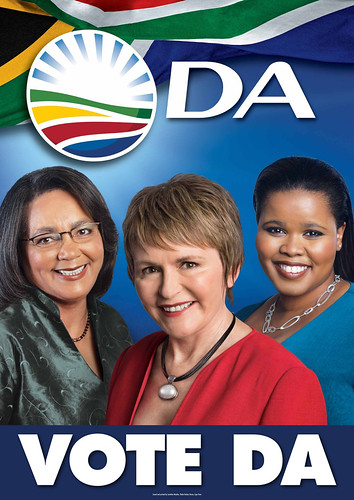
25 June 1955, the Kliptown Conference was convened, from which the cornerstone of our constitution, The Freedom Charter, was debated and promulgated. Fast-forward some 56yrs, and it looks like yet again Kliptown will take another page in South Africa’s history books as the DA ostensibly launched their election manifesto for this year’s municipal elections. However, what happened there was far more than that.
Last Saturday, the DA unveiled itself as an entirely new party.
It was most certainly no longer the party of the much maligned 1999 “Fight Back,” campaign or the 2009 “Stop Zuma” drive; a party which had to rebut robust attacks from the ANC and press of being a “white,” and “negative,” party; essentially, a purely opposition party.
In it’s place what took the stage was a party clearly seeking to not be merely relegated to the seats of the opposition, a party hungry to win, and win as much as they can. To quote their slogan a party which “delivers for all.”
As impressed as I was, since Saturday I’ve been trying to understand the DA’s electoral strategy of focusing on service delivery with regards to capturing that undeniably integral black vote. For the black middle class, so-called Black Diamonds, it was obvious. The DA fairly believes that by highlighting what they have done in Cape Town – brought some sense and order to the city – they will capture that vote. However, I didn’t understand how they thought that would lead them to electoral success as the black middle class is not the majority of black South Africans, it is the black working class, and they, more than black South Africans as a whole, are the key to any meaningful electoral gain.
After countless hours listening to their speeches and analysis of the speeches; reading their documents, and analysis of those documents, following the DA twitterati on Twitter, it’s ironic then that all it took was for their 30sec ad spot, with a sweet Gogo telling how the DA has delivered for her, to make sense to me.
With that ad, what I saw was that the DA, could also gain success using this service delivery angle. The open toilet saga of course did nothing to dispel the prevailing image of the DA as a party concerned with dealing primarily with the concerns of their electorate, the suburbs. The truth is the DA has, and does also focus on delivering service and bettering the life of South Africa’s poor.
Everyone knows the phrase, “all politics is local,” and taken to it’s most extreme this can mean “am I fed? am I clothed? Do I have a roof over my head?” If the DA can prove that they can and deliver all these things, it wouldn’t be insane to believe the angry, dissatisfied at service delivery failure voter would turn to the DA.
Many times I’ve written it and said it; service delivery protests are a sign that our democracy is failing and not because of the ANC’s failure to deliver, but because the opposition – and by opposition I mean DA – does not speak to the needs of the average voter – and by average voter I mean black working class voter. Clearly though, with this campaign, they’re clearly trying to do that, and for that I applaud them.
But of course, there’s a ‘but.’
I’ve voted twice, ID in 2006 & COPE in 2009. Though at the time when asked, I would sidestep the question, I’ve never for a moment even considered voting for the DA. To put it bluntly, I believed that the DA was a party that sought to cater to the minority and had no interest in my interests, and with their actions to me reaffirming that, nothing they said would dissuade me of that.
It was only last month I wrote to a friend on Twitter, Zama, as we discussed the DA saying, “that the DA has failed to speak to my aspirations is a failure on their part, not mine.” As we lamented how “disappointed” we were in the ANC, Zama summed up how I felt when she said she’d rather not vote, than vote for the DA. She again perfectly captured how I felt when she said, “Ultimately a voter is a customer paying through their taxes…We choose a product that speaks to our needs.” I can’t speak for Zama, but personally looking over those tweets after Saturday, I didn’t feel that they applied to this new DA.
It then of course stands to reason to wonder; if as a “disappointed” supporter of the ANC’s agenda, faced with a DA that is no longer “a party purely for the minority” could I, or would I vote for them?
No.
It’s not because I believe the DA is a “white party,” which since Saturday more than ever it clearly is not. However, the reason I still wouldn’t vote for the DA is because when everything is boiled down I fundamentally disagree with their core policies.
Yes, I want good governance, and am as angry as any other South African when every two seconds I hear of yet another example of ANC wastefulness, corruption & cronyism. However, I also don’t feel that the DA, with it’s emphasis on potholes, rubbish collection and the like speaks to my aspirations. To be fair, these being local elections, potholes, rubbish collection and the sorts are the issues that are being dealt with.
However, the DA has given us “The Cape Town Story.”
In the grandiose manner of all political manifestos, it states, (the story) began on the 1st of March 2006, a day “future generations will recognise” as being a “watershed” for South Africa, as it was “the first time since 1994, citizens removed an incumbent political party through the ballot box.” Moreover, in this document is found the essence of the DA: “The Open Opportunity Society for All.”
This vision, or philosophical orientation as the DA refers to is based on the idea that South Africans are “free and equal in rights,” that “each has the opportunity to go as far as their talents will take them,” a ours is a society “in which every South African has the space to be whatever they wish to be.”
That, I disagree with fundamentally.
It’d be easy to say that this philosophical orientation directly opposes what Lindiwe Mazibuko who said, “we live in a decidedly unequal society,” but giving the DA allowance for electioneering grandstanding it is clear Mazibuko was espousing the DA’s view.
Even though the “philosophical orientation” of the DA does have the bluster of electioneering I’d argue that it speaks directly to their average existing voters whom I find do believe that to be the South African reality, however that is another matter for another day.
In essence, I believe the DA does recognise that South Africa is not an equal society but as Mazibuko said “we differ from the ANC on the method of addressing these imbalances.” Gareth Van Onselen, national head of the DA’s 2011 election communication, said as much to me in a discussion I had with him on Twitter.
However, as Van Onselen put it – to use a term The Cape Town Story, prefers when referring to ANC government but one Van Onselen didn’t – the current “regime’s” policy of democratic representivity is racist, not because it’s bigoted, but because it is “legislated discrimination.”
Van Onselen was also kind enough to provide me with a document on the DA’s policy on transformation and it reinforced what I believed. Though there may be questions and doubts I have about the policy itself, they do have one, and do recognise inequality is a problem in South Africa.
In my, and the opinion of others far smarter and more well read than I am, the structural inequalities in South Africa as a result of Apartheid are South Africa’s most pressing concern. As Prof. Sampie Terreblanche in his seminal, “A History of Inequality In South Africa,” concluded; real redress in South Africa has not occurred in South Africa nor will it with our current economic system; a system that came about from our negotiated settlement, the elite compromise, Professor Terreblanche terms it, a compromise that ceded political power to the black majority but left real economic power in the hands of white South Africa.
I agree with Prof. Terreblanche and believe our post-1994 economic system makes real redress impossible, both the DA and ANC recognise we need it. However, they have very different policies on how to get there.
Beyond that though, I question just how serious of an issue the DA sees it as.
If the Cape Town Story is to be seen as “a template for a truly free South Africa,” as its subtitle says, why is there no section on transformation? Why is it the only time that transformation is mentioned is in a quote from Helen Zille’s Budget Speech of 2008, where she disparaged transformation and then reframed it to mean providing, “excellent basic services to all?”
Just as I cannot like another lamb to the slaughter vote for the ANC even though I know they are in no way truly committed to dealing with cronyism, the root cause of why their policies do not work, I also cannot vote for the DA, a party which does not recognise the need for transformation to be South Africa’s primary concern.
It may feel like it, but it wasn’t too long ago when Moeletsi Mbeki said South Africa’s Tunisia Day would come in 2020. In a blog I wrote on that topic, in support of that, argued that South Africa could face a Tunisia Day if people do not feel that they have a credible opposition to vote for, a not so subtle swipe at the DA.
Electorally, as a strategy, I feel that the DA is on the right track. They are reaching out beyond the dappled sunshine leafy enclaves of South Africa’s suburbs into the townships of South Africa and that can only be good for democracy.
I wish I could say that I tweeted this, but there were two tweets, both sent as the DA2.0, the DA that I believe to be the DA I’d always been dreaming of was launched. One was from Gus Silber who wrote:

Though Sipho Hlongwane fairly questioned the DA’s use of struggle language, saying they “mixed like oil and water,” the launch as a whole recast the DA as a whole new party.
The second tweet was one at the time I felt, though funny, was somewhat cynical. In reply to my asking if it was just me who felt that the launch was the DA turning a corner, Liam Lynch said:

It’s sad to say, but that to me does sum up DA 2.0. It looks all shiny and new, but underneath that veneer, it’s the same old party that it always was.